
I want LightBI to understand more kinds of operational data.
That sounds like an obvious goal, but semantic coverage creates a dangerous temptation: once the system becomes good at recognizing patterns, it becomes easy to let recognition turn into unsupported certainty.
A large part of LightBI therefore exists not to answer more questions, but to know when to stop.
Recognizing a concept is only the beginning
A field called DeliveryFee is fairly easy to interpret. Amt is harder. Value2 says almost nothing without its neighbors and actual values.
The Semantic Registry provides governed vocabulary and rules. The Micro Semantic Brain broadens recall with synonyms, conceptual relationships and cross-domain bridges. But it is not the final authority.
It can say “look here.” Governed evidence still decides whether anything may run.
Suggestion and execution permission are different things
Soft semantic recall can surface a candidate that rigid rules might miss. Resolver logic, grain, readiness and metric preflight then decide whether the candidate has enough evidence to become an executable action.
If the evidence does not hold, keeping the result unknown is often the correct behavior. Unknown is not impressive in a demo, but it is useful in a real product.
Sample to understand, full data to calculate
LightBI intentionally uses bounded samples to understand large sources quickly. That works well for schema, rough distributions and semantic context.
It does not mean the sample has authority to answer every analytical question. We caught a case where a sampled period comparison suggested roughly -15% while the full dataset was above +6%. Both calculations were mechanically correct for their input. Only one input scope was appropriate for the question.
Samples can support context and planning.
Full source scope is required when the governed calculation needs the complete dataset.
The same label does not make the same entity
Multi-file analysis has the same problem. Two files containing a Customer field do not automatically share an identity contract. Two fields called Revenue do not prove compatible grain or reporting periods.
LightBI therefore does not treat matching labels as permission to join. A Focus Subject can collect evidence across sources while preserving source identity and disclosure.
Deep BA should not tell a story beyond the evidence
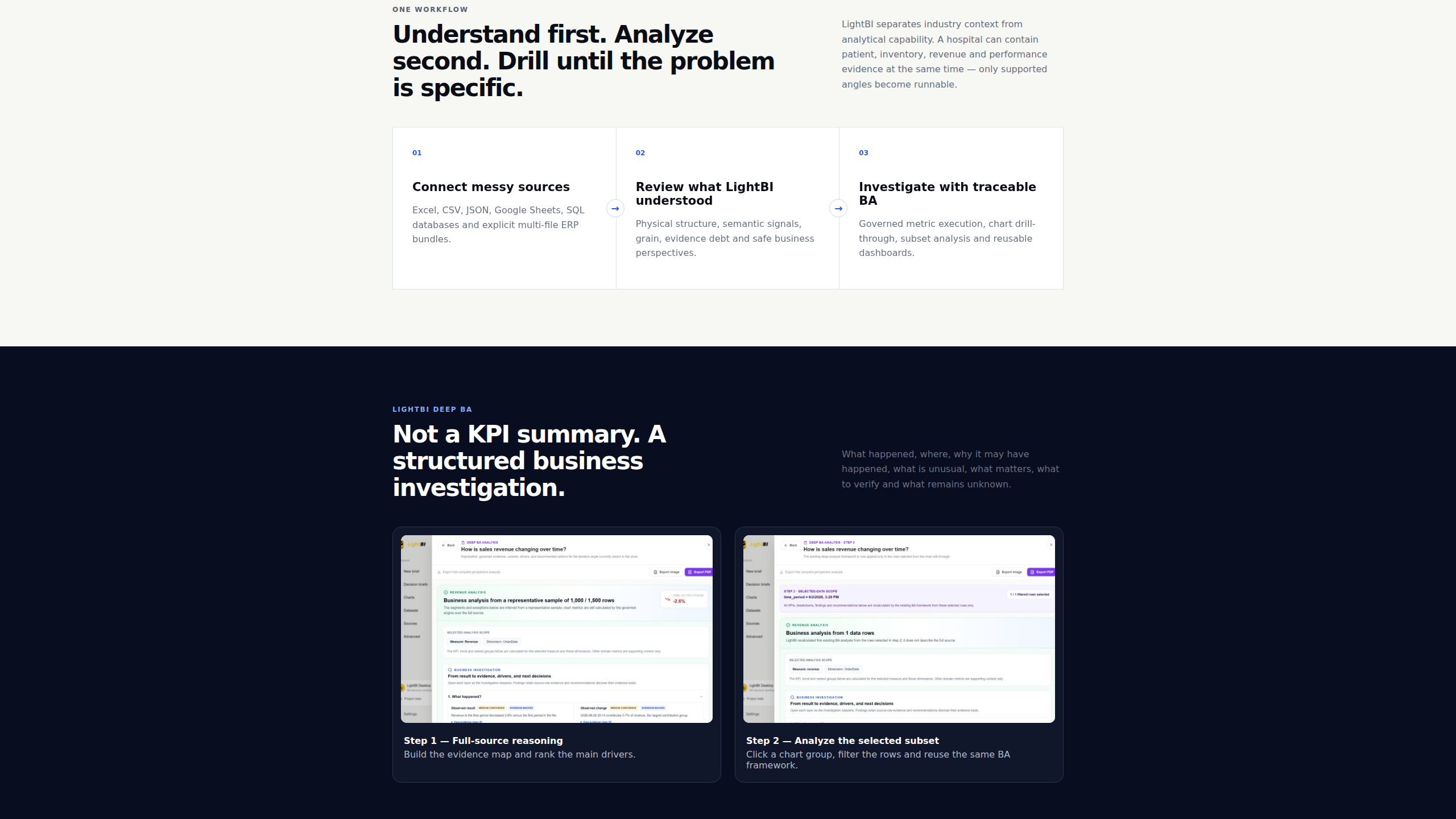
Deep BA is useful because business users rarely need another KPI tile. They need a structured investigation: what happened, where, what might be driving it, what is unusual and what should be checked next.
That narrative becomes dangerous if evidence is detached from it. Findings should retain source scope, confidence, limitations and drill-through into the rows that produced them.
AI can help express a governed finding more clearly. It should not upgrade an uncertain finding into a confident conclusion.
Getting smarter by knowing when to stop
I still want LightBI to learn more domains, synonyms and relationships. I simply do not want broader recall to become a system that always has an answer.
For business data, knowing when to stop is also a form of intelligence.
No approved comments yet.