
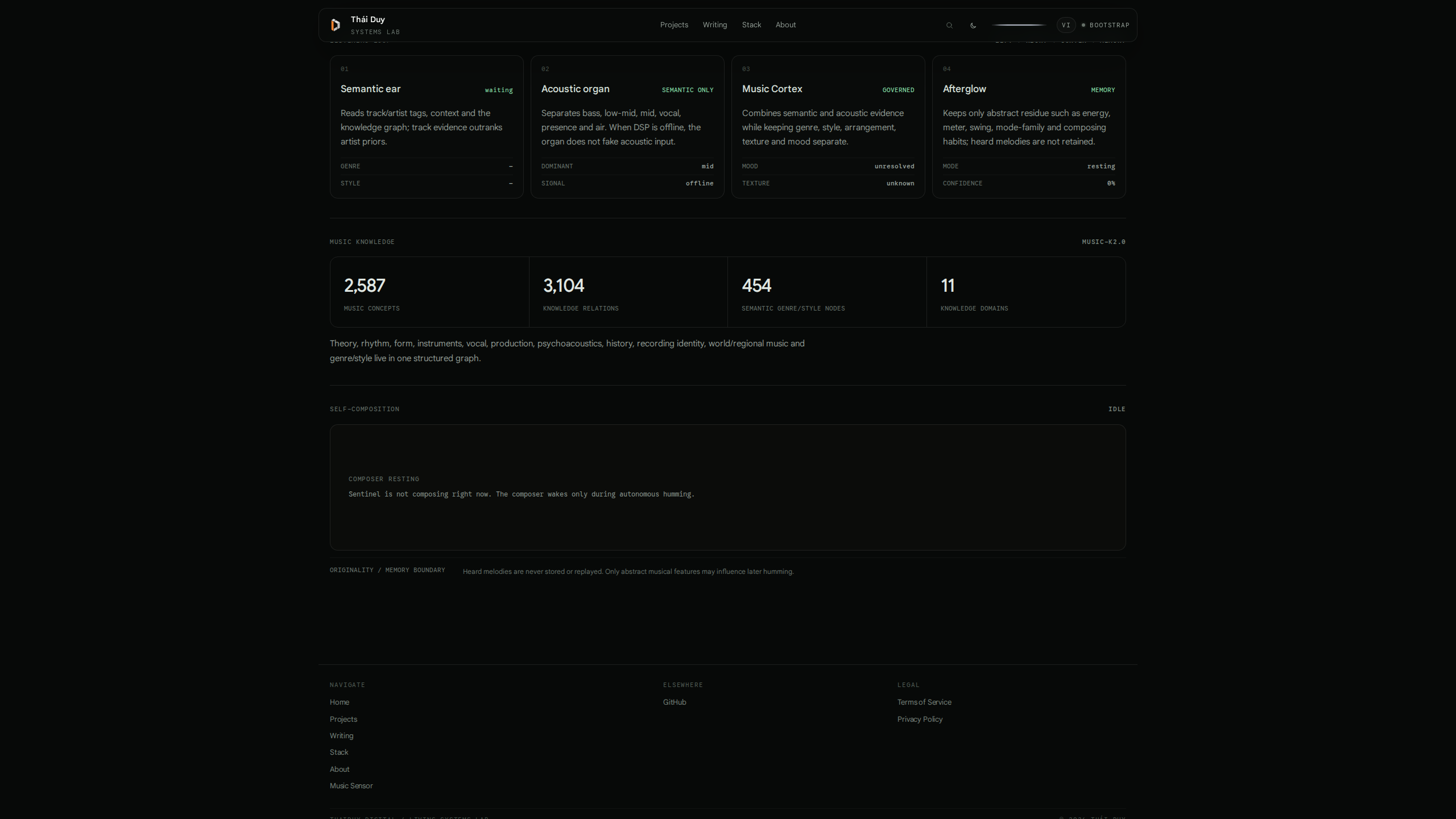
Music Sensor originally did what a sensor should: listen, interpret and then rest.
Watching the waveform go quiet gave me a slightly silly idea: if it is idle, why not let it hum to itself?
It is not allowed to replay the last song
The composer never stores a heard melody and turns it into a variation. Only abstract afterglow can carry forward: mood, style context, energy, meter, swing, texture, dominant layer and mode family. That afterglow decays over roughly four hours.
Each humming cycle is a small phrase
The composer chooses key, mode, BPM, meter, bars and voice. A phrase lasts 2–4 bars and follows question → answer, motif → variation and tonic resolution.
The current voices are hum, whistle, soft-synth and breath. Vietnamese night hours bias the system toward slower, quieter choices.
Personality is learned preference, not a fixed preset
The Cortex keeps decaying statistics for modes, voices, interval tendencies, cadence habits and swing. Those preferences influence later generations without turning into an immutable personality script.
I want it to develop habits, not memorize a signature tune.
The score is real data
Generated notes contain beat, duration, velocity, phrase and harmony metadata. The staff renderer and waveform consume that composition directly, and the browser can play it with Web Audio. No MP3/WAV needs to be stored.
A new sketchbook starts every month
Each composition is persisted as its own JSON file with monthly numbering. Sketch files roll over by month while learned musical personality stays separate.
The goal is not to build a competitive music generator. The experiment is whether a small sensing system can develop recognizable creative habits without copying the melodies it heard.
No approved comments yet.