
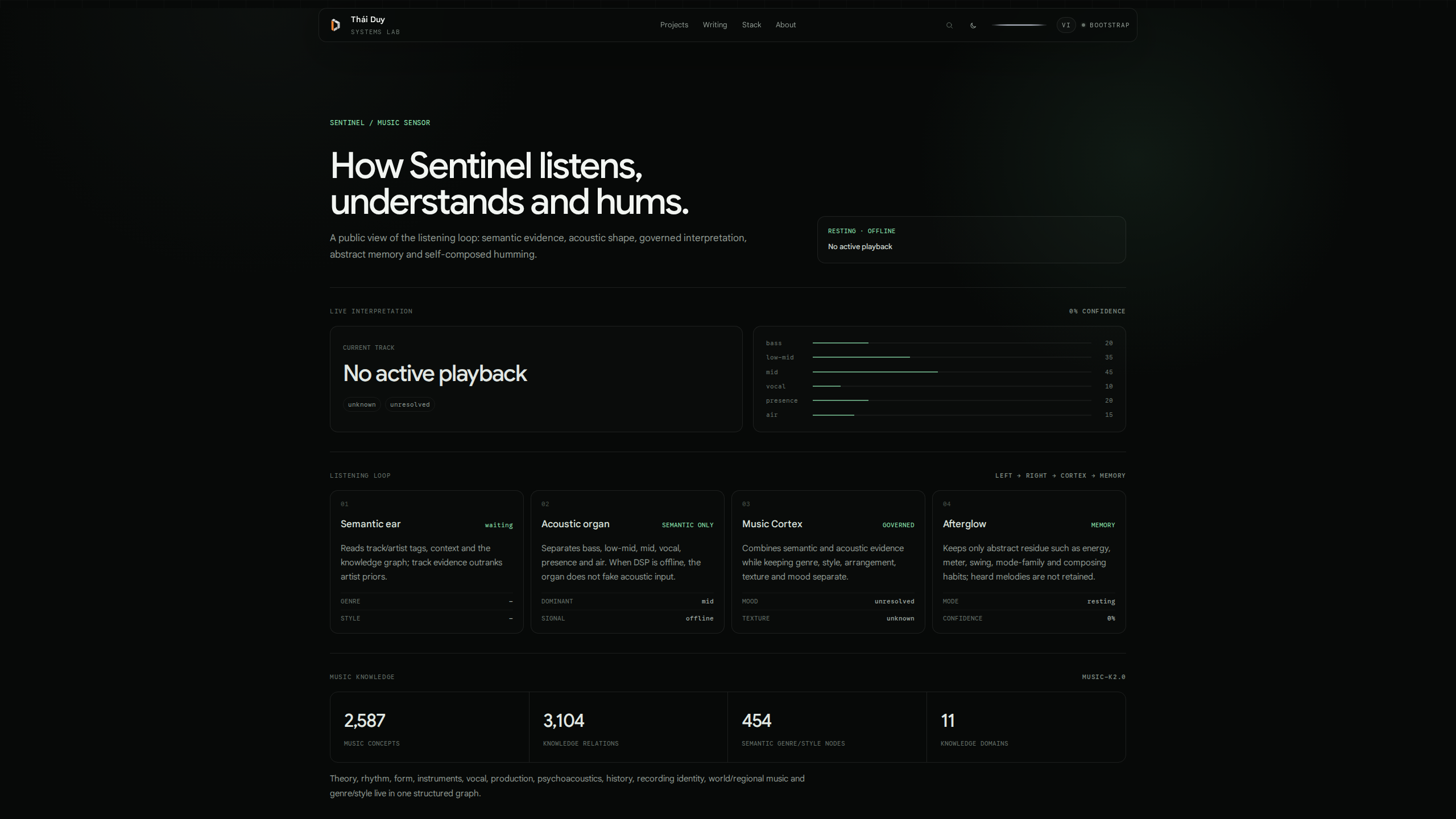
From the outside it sounds strange: a project born from security monitoring suddenly grows a Music Sensor.
For me it became a clean test bed for Sentinel's two-hemisphere architecture.
One side reads meaning, the other hears signal
The Semantic Ear works with identity, catalog tags and contextual sources. The Acoustic Organ works with local DSP: bass, low-mid, mid, presence, air, vocal, energy, flux and texture.
The Music Cortex fuses both into a public interpretation without pretending the two evidence families are the same.
One side knows what people call the recording. The other only knows what it can hear.
The disagreement is useful
Catalog genre and performed acoustic shape do not always line up. Preserving both is a good rehearsal for the same ambiguity that appears in security telemetry.
K2.0 became a real music knowledge graph
The current authored graph contains 2,587 general music concepts and 3,104 relations across theory, rhythm, form, instruments, production, psychoacoustics, recording identity, regional music and genre/style.
It can remember context without storing heard melody
Recording identity and abstract interpretation can be remembered. Heard melodies are not stored and replayed by the public humming system. Only abstract features such as energy, meter, swing, texture and mode family may influence later behavior.
The long-term experiment is bigger than song recognition: combine semantic context with continuous signals while keeping the evidence sources distinct.
No approved comments yet.